Cable-Free RTLS Infrastructure: Extend Your Coverage
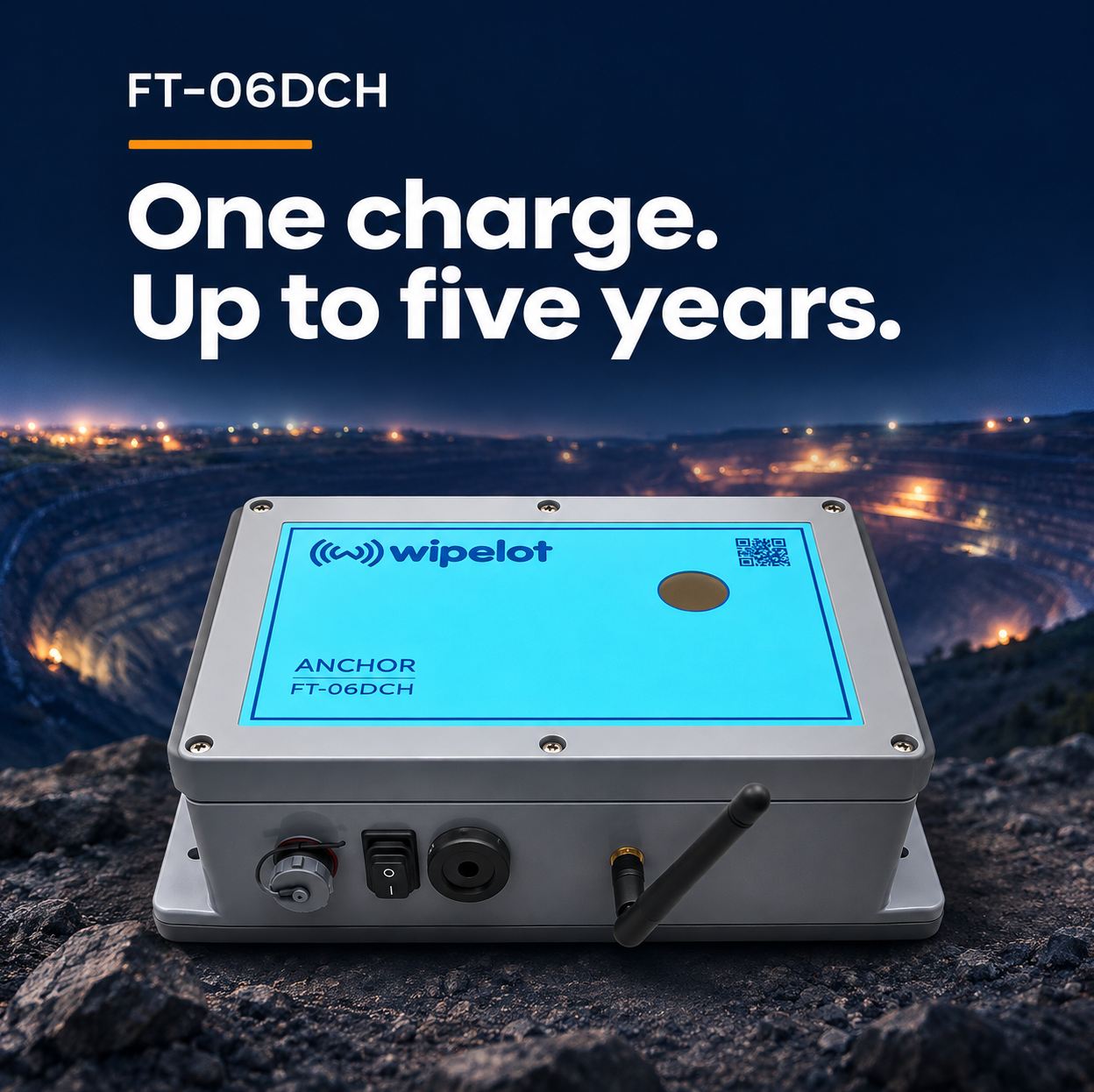
FT-06DCH / Industrial UWB anchor
Cable-Free RTLS Infrastructure: Extend Your Coverage
Wipelot battery anchors run for 3–5 years on a single charge. Their wireless mesh carries data from anchor to anchor, extending RTLS coverage beyond a gateway’s direct radio range. Each battery anchor needs zero power or data cabling.

Battery evolution
From backup power
to primary power.
The first FT-06DCH had a battery for the hours when the power went out. Fifteen years of work on power consumption turned that backup into the anchor’s primary power source.
Emergency backup
When the lights went out
The original battery kept the anchor running through a power cut. In mines and heavy industry, that continuity mattered for systems such as man-down alerts.
Rechargeable operation
Beyond the nearest outlet
Lower power consumption made it practical to work where mains power was unavailable. For many crews, recharging roughly every two weeks fit the way they worked.
TDMA-synchronized operation
Years between charges
TDMA synchronization reduces the time each radio spends awake. The anchors can operate for years while forwarding data wirelessly through the mesh.
Wireless mesh & TDMA
Coverage grows
one hop at a time.
As a mine heading advances beyond the gateway’s radio range, place another Wipelot anchor within reach of a neighbouring anchor. The new anchor passes data back through the mesh, one wireless hop at a time, until it reaches the Wipelot Gateway.
Wipelot’s time division multiple access (TDMA) synchronization gives each exchange a time slot. The sending and receiving anchors wake for that slot and can return to a low-power state between exchanges.
The 3–5 year battery life depends on the operating profile, including how often an anchor forwards traffic, and on site conditions. Cable-free operation applies to the battery anchors. Gateway power and backhaul are planned separately.
TX = transmit · RX = receive. Example route and schedule.
Explore Wipelot
Where would you
like to go next?

Deployment planning
Where does your
power line end?
Bring us a mine plan or plant layout. We’ll help you plan anchor spacing, wireless relay paths and gateway locations for your site.